Your dentist has mentioned a referral, and the word surgeon has landed harder than intended.
In dentistry that word covers a wide range, from a routine wisdom tooth to jaw reconstruction. Most referrals sit at the routine end.
Oral surgeon vs dentist is a question of scope rather than severity. General dentists handle the majority of extractions and many implants. Oral and maxillofacial surgeons take the cases that need extra surgical training, deeper sedation, or hospital facilities.
Oral Surgeon vs Dentist, the Difference
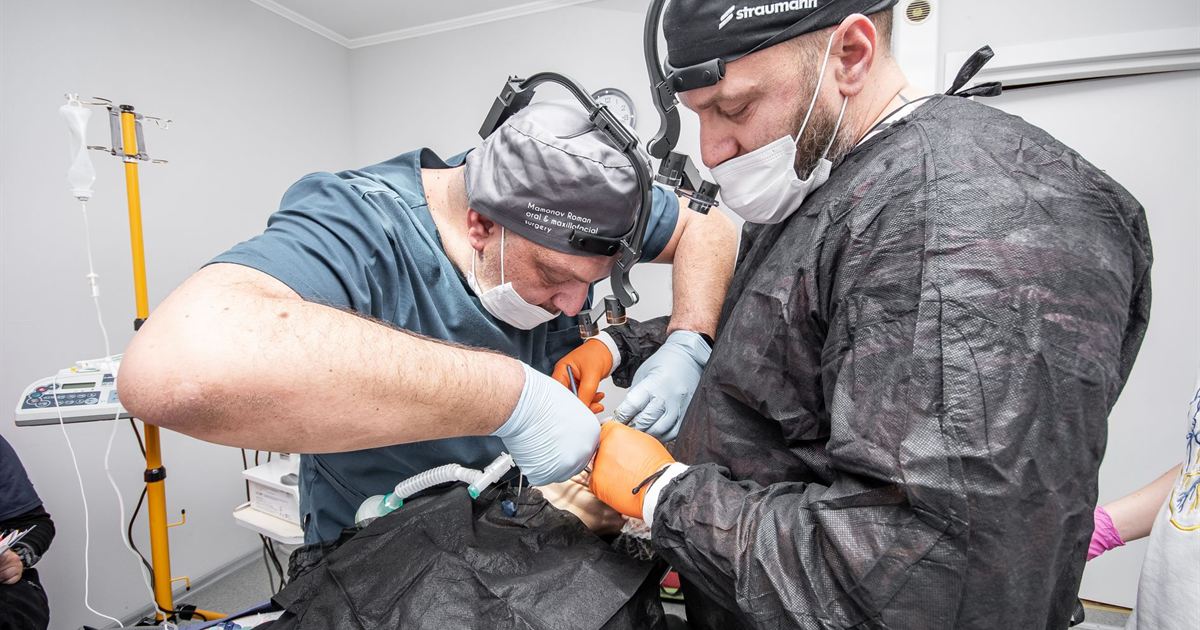
Both are dentists. An oral and maxillofacial surgeon completes dental school and then four or more years of hospital-based surgical residency, training in complex extractions, implant surgery, jaw surgery, facial trauma, pathology, and anesthesia. A general dentist completes dental school and covers the full range of routine care, including many extractions and implant placements. The dividing line is procedural complexity and the level of sedation required, not how serious your situation is.
Many general dentists complete substantial additional training in implants or surgical extractions.
Which is why the line moves from practice to practice.
What a General Dentist Handles
More than most people assume. A general practice is where the bulk of dentistry happens.
Examinations, X-rays and cleanings
Fillings, crowns and bridges
Root canals, particularly front teeth and simpler back teeth
Straightforward extractions, where the tooth is fully erupted and accessible
Many implant placements, depending on training and the site
Dentures and partials
Veneers, bonding and whitening
Gum treatment, including deep cleaning
Emergency care, including abscess drainage
Nightguards and sports guards
Your general dentist knows your history, your X-rays over time, and how you handle treatment. That continuity is worth something, and it is why the first conversation about any procedure belongs there.
What Goes to an Oral Surgeon
Referrals cluster around a handful of situations.
Procedure
Why it goes to a surgeon
Impacted wisdom teeth
Bone removal, nerve proximity
Teeth broken at the gumline
Surgical access needed
Bone grafts and sinus lifts
Specialist surgical technique
Complex implant cases
Limited bone, multiple sites
Jaw surgery for bite correction
Hospital procedure, works with an orthodontist
Facial trauma
Fractures of the jaw or face
Biopsies and lesion removal
Pathology assessment
Full sedation or general anesthetic
Facilities and anesthesia training
Cleft and reconstructive work
Multidisciplinary care
Nerve proximity is a recurring reason. Lower wisdom teeth sit close to the nerve supplying the lip and chin, and where a scan shows that relationship is tight, a surgeon takes it.
Sedation is the other recurring reason, and it has nothing to do with the tooth. Some people need deeper sedation than a general practice can safely provide.
The Grey Area
Plenty of procedures could go either way, and where they land depends on the individual dentist.
Wisdom teeth that are fully erupted and straightforward are routinely removed in general practice. Impacted ones usually are not. Single implants with good bone are commonly placed by general dentists with implant training. Multiple implants with grafting usually go to a surgeon.
There is nothing improper about this variation. A dentist referring a case is telling you it sits outside what they do routinely, which is a good sign rather than a worrying one.
The useful question to ask is simply how often they do this particular procedure. Most will answer directly, and either answer is fine.
Our post on wisdom teeth removal covers where that particular line usually falls.
Why You Might Be Referred
Five common reasons, none of which mean your case is worse than described.
Nerve or sinus proximity on a scan, where the margin is small.
The tooth is not accessible, broken at the gumline or fully impacted in bone.
You need deeper sedation than the practice offers.
A medical condition makes anesthesia or bleeding management more complex.
The case needs grafting or work in the sinus.
Ask your dentist which of these applies. It takes thirty seconds and it usually removes most of the anxiety.
Ask whether the referral is required or recommended. Sometimes it is a preference; sometimes it genuinely cannot be done elsewhere.
What a Referral Means for You
Practical consequences worth knowing before the appointment.
Timing. A referral adds a consultation, so expect a few extra weeks except where it is urgent.
Cost. Specialist fees are usually higher than general practice fees for the equivalent procedure. Insurance often covers oral surgery under a different category than routine dental work, sometimes under medical rather than dental. Check both before assuming.
Records. Your X-rays and notes go with the referral, so you should not need repeat imaging, though a 3D scan is sometimes taken.
Aftercare. Follow-up is usually with the surgeon initially, then back to your general dentist. Be clear on who to call at each stage, since that gets muddled surprisingly often.
You keep your dentist. A referral is for one procedure. Everything else stays where it was.
The American Association of Oral and Maxillofacial Surgeons publishes patient information on what specialist training covers.
FAQs About Oral Surgeon vs Dentist
What is the difference between an oral surgeon and a dentist? Both are dentists. An oral and maxillofacial surgeon has completed four or more years of additional hospital-based surgical residency covering complex extractions, jaw surgery, facial trauma, and anesthesia. A general dentist handles the full range of routine care including many extractions and implants. The split is procedural complexity, not severity.
Do I need an oral surgeon for a tooth extraction? Usually not. Most extractions are done in general practice. Referrals happen for teeth that are impacted, broken at the gumline, close to a nerve, or where deeper sedation is needed. Your dentist decides after looking at the X-ray.
Does being referred mean my case is serious? Not by itself. Referrals are most often about surgical access, nerve proximity, or sedation, none of which say anything about how serious the underlying problem is. Ask which specific reason applies to you.
Is an oral surgeon more expensive? Specialist fees are usually higher for an equivalent procedure. Insurance treatment differs, since oral surgery is sometimes covered under medical rather than dental benefits. Check both policies before the appointment rather than after.
Can my general dentist place implants? Many do, particularly single implants in sites with good bone. Complex cases involving grafting, sinus lifts, or several implants more often go to a surgeon. Ask how many your dentist places and how often, and take either answer at face value.
Ask Us Which You Need
An examination and an X-ray settle whether a procedure can be done here or whether a referral serves you better.
Call (208) 356-5601 or see our oral surgery page.
Madison Park Dental, 345 N 2nd E Ste 2, Rexburg, ID 83440. Rated 4.9 stars across 229 Google reviews.
Reviewed by Dr. Matthew Griffeth, Madison Park Dental.This article is general information, not dental advice.
☏
Ready to book?To learn more or schedule an appointment, call Madison Park Dental at (208) 356-5601 or visit us at 345 N. 2ND E., Suite 2, Rexburg, ID 83440.
Matthew Griffeth
Dr. Matthew M. Griffeth is passionate about patient education and preventive care. His mission is to help patients achieve long-lasting oral health with simple, effective habits at home.
Keep Reading
Related Articles
Ready to Transform Your Smile?
To find out more about the dental services offered at Madison Park Dental, call (208) 356-5601 or schedule an online consultation. You can also visit us at 345 N. 2ND E., Suite 2, Rexburg, ID 83440.