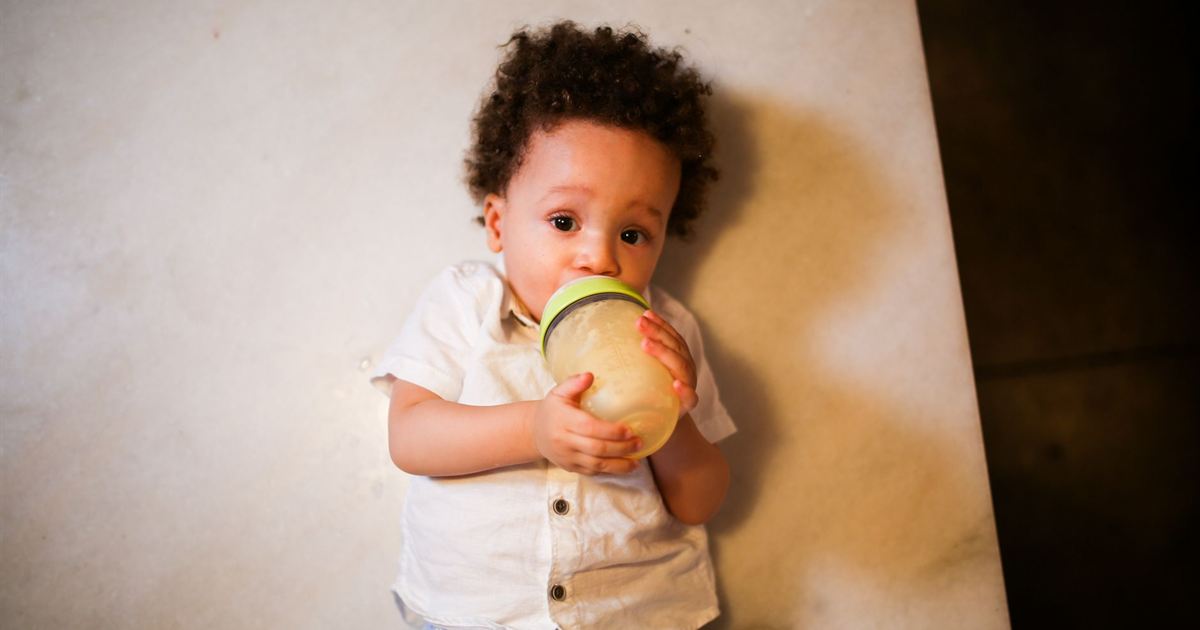
Your child falls asleep with a bottle, which is peaceful, effective, and the single most common cause of decay in toddlers.
The problem is not the milk itself. It is how long it sits against the teeth.
Baby bottle tooth decay develops when sugary liquids, including milk and formula, pool around a child’s teeth for long periods, particularly overnight when saliva flow drops. The upper front teeth are affected first and it progresses quickly in young enamel.
What Causes Baby Bottle Tooth Decay
Bacteria in the mouth feed on sugars and produce acid that dissolves enamel. Milk, formula, and breast milk all contain natural sugars, so prolonged contact matters as much as what is in the bottle. Sleeping with a bottle is the classic cause, since saliva flow drops during sleep and there is nothing to wash the liquid away. Sipping from a bottle or sippy cup throughout the day has the same effect, keeping teeth under repeated acid attack.
Frequency matters more than quantity.
A cup of juice drunk in ten minutes does far less harm than the same cup sipped over three hours.
Early Signs to Look For
Lift your child’s upper lip and look at the front teeth where they meet the gum. That is where it starts.
White chalky lines or spots along the gumline are the earliest sign. This stage is reversible with fluoride and habit changes, which is why it is worth checking.
Yellow or brown discoloration means decay has progressed into the enamel.
Visible pits or holes, usually on the upper front teeth first.
Dark or blackened teeth indicate advanced decay.
Swollen or bleeding gums around the affected teeth.
Pain, or a child refusing cold food and favoring one side when eating.
Fussiness with no obvious cause, since young children cannot localize dental pain reliably.
The upper front teeth are affected first since the tongue covers and protects the lower ones during feeding. Decay appearing on the lower front teeth usually indicates the process is well advanced.
Which Drinks Cause It
Drink
Risk in a bottle
Water
None, safe at any time
Plain milk
Moderate, high overnight
Formula
Moderate to high, high overnight
Breast milk
Moderate, high with prolonged night feeding
Fruit juice
High, acidic and sugary
Squash or cordial
High
Sweetened tea
High
Soda
Very high
Juice is the one most parents underestimate. It is frequently perceived as healthy, and in a bottle sipped over an hour it delivers both sugar and acid to the teeth continuously.
Breast milk deserves a careful note. Breastfeeding is beneficial and prolonged night-time feeding once teeth are present does increase decay risk. The answer is wiping or brushing the teeth after feeds rather than stopping.
Never dip a pacifier in honey, syrup, or anything sweet. Honey is unsuitable for children under one for unrelated reasons.
Breaking the Bedtime Bottle Habit
The advice that is easy to give and hard to follow, so here is a workable version.
Dilute gradually. Over a week or two, replace an increasing proportion of the bottle contents with water until it is entirely water. Most children accept this where an abrupt switch fails.
Move the bottle earlier. Give it as part of the bedtime routine but before teeth brushing, rather than in the cot.
Substitute the comfort, not just the bottle. For many children the bottle is soothing rather than nutritive. A story, a comfort object, or rocking replaces the function.
Accept a few difficult nights. Usually three to five. It is genuinely hard and it is short.
Move to an open or free-flow cup by around age one, and away from bottles entirely by eighteen months where possible.
Avoid all-day sipping, which is the daytime version of the same problem. Offer drinks at set times, and water in between.
If your child truly cannot settle without something in the cot, water is entirely safe.
Daily Prevention
Small habits that prevent nearly all of this.
Wipe the gums with a clean damp cloth after feeds, even before teeth appear.
Start brushing as soon as the first tooth comes through, twice a day.
Use fluoride toothpaste, a smear the size of a grain of rice under three, a pea-sized amount from three to six.
Supervise brushing until around seven. Children lack the manual dexterity before then regardless of willingness.
Brush last thing at night after the final drink.
Check the front teeth weekly by lifting the lip.
Book the first dental visit by age one, covered in our child’s first dental visit post.
Avoid sharing spoons or cleaning a pacifier in your own mouth. The bacteria that cause decay are transmitted from caregivers.
The American Academy of Pediatric Dentistry publishes parent guidance covering all of these.
What Treatment Involves
It depends on how far it has progressed, which is the argument for checking early.
White spot stage. Fluoride varnish, habit changes, and better brushing. Reversible at this point.
Small cavities. Fillings, sometimes with silver diamine fluoride to arrest decay in very young or anxious children.
Larger cavities. Stainless steel crowns on back teeth, which are more durable than fillings in children.
Extensive decay in front teeth. Sometimes restored, sometimes extracted where too little tooth remains.
Infection or abscess. Treatment of the affected tooth, sometimes extraction.
Extensive treatment in a young child. Sometimes done under sedation or general anesthetic where cooperation is not possible, which is a specialist referral.
Baby teeth matter. They hold space for the adult teeth, affect speech and eating, and decay in them causes real pain and infection. Losing one early can crowd the permanent tooth that follows.
FAQs About Baby Bottle Tooth Decay
What causes baby bottle tooth decay? Prolonged contact between teeth and sugary liquids, including milk, formula, breast milk, and juice. Sleeping with a bottle is the most common cause, since saliva flow drops overnight and nothing washes the liquid away. All-day sipping from a bottle or sippy cup does the same thing.
Can I give my baby a bottle of milk at bedtime? Best given as part of the bedtime routine and followed by brushing, rather than taken into the cot. If your child needs a bottle to settle, water is entirely safe. Diluting the milk gradually with water over a week or two is the transition most children accept.
What are the first signs of baby bottle tooth decay? White chalky lines or spots along the gumline of the upper front teeth. Lift your child’s upper lip to check, since this area is otherwise hidden. At the white spot stage it is reversible with fluoride and habit changes, which makes early checking worthwhile.
Does breastfeeding cause tooth decay? Breastfeeding is beneficial, and prolonged night-time feeding once teeth are present does increase risk, since breast milk contains natural sugars. Wiping or brushing the teeth after night feeds addresses it. This is not a reason to stop breastfeeding.
Do baby teeth need treating if they fall out anyway? Yes. They hold space for the adult teeth, affect speech and eating, and decay causes genuine pain and infection. Back baby teeth are not replaced until around age twelve, so a decayed molar left untreated at four means eight years of problems.
Book a Check
Lift your child’s lip and look at the gumline. If you see white or brown lines there, book an appointment.
Call (208) 356-5601 or see our children’s dentistry page.
Madison Park Dental, 345 N 2nd E Ste 2, Rexburg, ID 83440. Rated 4.9 stars across 229 Google reviews.
Reviewed by Dr. Matthew Griffeth, Madison Park Dental.This article is general information, not dental advice.
☏
Ready to book?To learn more or schedule an appointment, call Madison Park Dental at (208) 356-5601 or visit us at 345 N. 2ND E., Suite 2, Rexburg, ID 83440.
Matthew Griffeth
Dr. Matthew M. Griffeth is passionate about patient education and preventive care. His mission is to help patients achieve long-lasting oral health with simple, effective habits at home.
Keep Reading
Related Articles
Ready to Transform Your Smile?
To find out more about the dental services offered at Madison Park Dental, call (208) 356-5601 or schedule an online consultation. You can also visit us at 345 N. 2ND E., Suite 2, Rexburg, ID 83440.