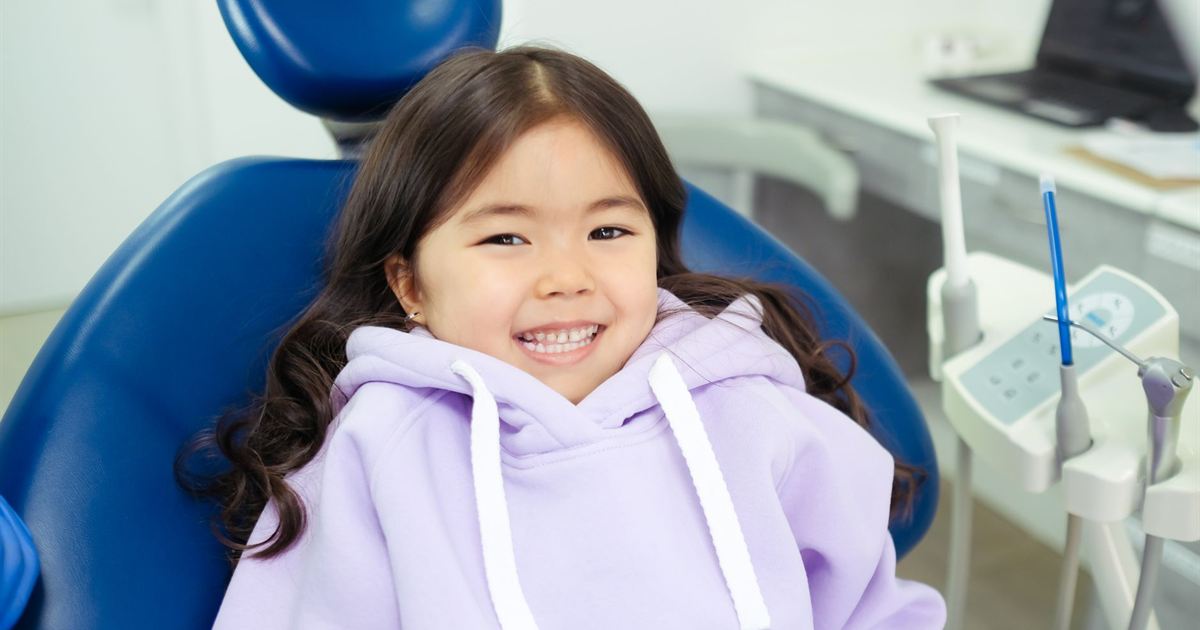
Most parents book the first appointment later than recommended, usually around three or four, and often since something looks wrong.
Earlier is easier for a reason that has nothing to do with teeth.
A child’s first dental visit should happen by their first birthday, or within six months of the first tooth appearing. At that age the visit is short, gentle, and mostly about getting them familiar with the room, which is what makes every later appointment straightforward.
When to Book a Child’s First Dental Visit
The recommendation from the American Academy of Pediatric Dentistry is by age one, or within six months of the first tooth coming through, whichever is earlier. That first appointment is brief and largely about familiarity rather than treatment. It gives you a chance to ask about bottles, cups, thumb sucking, teething, and brushing before habits are established. Children who start this early are consistently more comfortable at later appointments.
If your child is older than one and has never been, book now rather than waiting for a milestone.
Starting at four is far better than starting at seven.
What Happens at the Appointment
Short, gentle, and less clinical than most parents expect.
Fifteen to thirty minutes. Often shorter for a very young child.
A knee-to-knee examination for babies and toddlers. You sit facing the dentist, your child lies back across both your laps with their head in the dentist’s lap. They can see you the whole time, which is why it works.
A look at the teeth and gums, checking for early decay, how the teeth are coming through, and how the bite is developing.
A gentle clean if appropriate, sometimes just a soft brush.
Fluoride varnish, painted on quickly. Most children accept it easily.
No X-rays normally at a first visit, except where there is a specific reason.
A conversation with you about brushing technique, diet, bottles, and habits. This is often the most valuable part.
Crying at this age is normal and expected, and it is usually about being held still by a stranger rather than about discomfort. Nobody in the room will be surprised.
How to Prepare Them
Preparation matters more than anything that happens in the chair.
Time it well. After a nap and after a snack. A tired hungry toddler is a difficult appointment regardless of how good the dentist is.
Keep it low key. Mention it briefly, the day before or the morning of. Building it up over a fortnight signals that it is a big deal.
Read a book about it. Several exist for this exact purpose and children respond well to knowing the sequence.
Play dentist at home. Count their teeth with a toothbrush, let them do it back to you.
Bring a comfort object. A toy or blanket.
Manage your own face. This is the real one. Children read parental anxiety instantly and accurately, and a parent who is nervous about the dentist transmits it without saying anything.
If you dislike the dentist yourself, consider whether the other parent or another adult is better placed for this appointment. That is not a failing, it is a practical choice.
Words to Avoid
Reassurance frequently introduces the idea it was meant to remove.
Avoid
Why
Say instead
“It won’t hurt”
Introduces the concept of hurting
“The dentist is going to count your teeth”
“Don’t be scared”
Suggests there is something to fear
“We’re going to meet someone new”
“Be brave”
Implies bravery is required
“You can hold Bunny when you sit in the chair”
“Just a quick check”
Sets up a broken promise if it takes longer
“They’ll have a look and we’ll go get lunch”
“Needle”, “drill”, “shot”
Words they will not have thought of
Let the dentist use their own vocabulary
“If you’re good, we’ll…”
Frames it as an ordeal to endure
Plan something pleasant afterward without conditions
Never use the dentist as a threat. “If you don’t brush, the dentist will drill your teeth” produces exactly the fear you would then have to undo.
Dental offices have their own language for equipment and procedures, developed for children. Let them use it rather than pre-loading words with different associations.
If It Goes Badly
Some first visits do not work, and that is a normal outcome rather than a failure.
A child who cries throughout, refuses to open, or will not leave your lap has still had a useful appointment. They came into the building, met the staff, saw the room, and left. That is genuine progress toward the next one.
Do not apologize for them in front of them, and do not label them as difficult. Children internalize that description quickly.
Consider a familiarization visit. Many offices will let a child come in simply to sit in the chair, ride it up and down, and leave with a sticker, with no examination attempted.
Try again sooner rather than later. Long gaps let apprehension build.
Ask about the approach. Tell-show-do, where each instrument is named, shown, then used, is standard in pediatric care and it works.
Where a child has a real need for treatment and cannot cooperate, options exist ranging from nitrous oxide to referral. That is a conversation for the appointment rather than something to worry about in advance.
Building the Habit Afterward
The first visit only pays off if it is followed by regular ones.
Every six months except where advised otherwise. Regular short visits with nothing happening are what build comfort.
Brush twice daily with a smear of fluoride toothpaste for under-threes and a pea-sized amount after that. Supervise until around seven, since children lack the dexterity before then.
Start flossing once teeth touch each other.
Watch the drinks. Juice, squash, and milk in a bottle at bedtime are the main causes of early decay. Our post on baby bottle tooth decay covers why.
Move to a cup by around age one.
Ask about sealants when the first permanent molars appear, around age six.
The American Academy of Pediatric Dentistry publishes parent guidance covering all of these.
FAQs About a Child’s First Dental Visit
When should my child have their first dental visit? By their first birthday, or within six months of the first tooth appearing, whichever comes first. If your child is older and has not been yet, book now rather than waiting. Early visits are about familiarity rather than treatment, which is what makes later ones easy.
What happens at a first dental visit? A short examination of the teeth and gums, often with your child lying across your lap facing you, sometimes a gentle clean and fluoride varnish, and a conversation with you about brushing, diet, and habits. X-rays are not usually taken at a first visit.
Will my child need X-rays? Not normally at a first visit. X-rays are taken when there is a specific reason, such as a suspected cavity between teeth or a concern about how adult teeth are developing. Frequency is based on individual risk rather than a fixed schedule.
My child is terrified of the dentist. What should I do? Tell the office when you book, so they can allow extra time. Ask about a familiarization visit with no examination. Avoid words like hurt, scared, and brave beforehand, and be aware that children read parental anxiety very accurately. Short frequent visits work better than long gaps.
Do baby teeth really matter if they fall out anyway? Yes. They hold space for the adult teeth, affect speech and eating, and decay in them causes real pain and infection. Losing one early can crowd the adult tooth that follows. Baby teeth set the pattern for how a child feels about dental care.
Book Their First Visit
Short, gentle, and mostly about getting comfortable in the room.
Call (208) 356-5601 or see our children’s dentistry page.
Madison Park Dental, 345 N 2nd E Ste 2, Rexburg, ID 83440. Rated 4.9 stars across 229 Google reviews.
Reviewed by Dr. Matthew Griffeth, Madison Park Dental.This article is general information, not dental advice.
☏
Ready to book?To learn more or schedule an appointment, call Madison Park Dental at (208) 356-5601 or visit us at 345 N. 2ND E., Suite 2, Rexburg, ID 83440.
Matthew Griffeth
Dr. Matthew M. Griffeth is passionate about patient education and preventive care. His mission is to help patients achieve long-lasting oral health with simple, effective habits at home.
Keep Reading
Related Articles
Ready to Transform Your Smile?
To find out more about the dental services offered at Madison Park Dental, call (208) 356-5601 or schedule an online consultation. You can also visit us at 345 N. 2ND E., Suite 2, Rexburg, ID 83440.