You went in for a cleaning and left with a treatment plan for something longer, more expensive, and spread across several visits.
The reaction is usually suspicion, and it is a fair one to check.
A dental deep cleaning, properly called scaling and root planing, removes bacterial deposits from the root surfaces below the gumline. A regular cleaning works above it. The distinction is not marketing, and the way to verify it is to ask for your pocket measurements.
What a Dental Deep Cleaning Is
Scaling and root planing cleans the surfaces of the tooth roots below the gumline, inside the pockets that form when gum disease has progressed. Scaling removes hardened deposits and bacterial film from the root. Root planing smooths the root surface so the gum can reattach and so deposits build up more slowly afterward. It is done with local anesthetic, usually across two or four appointments treating one section of the mouth at a time.
The target is the area a toothbrush physically cannot reach.
Once a pocket exceeds about four millimeters, nothing you do at home cleans the bottom of it.
How It Differs From a Regular Cleaning
Regular cleaning
Deep cleaning
Area treated
Above the gumline and just below
Root surfaces deep inside pockets
Purpose
Prevention
Treatment of active disease
Anesthetic
Not usually
Usually yes
Appointments
One
Two to four
Duration
30 to 60 minutes
45 to 90 minutes each
Follow-up
Six months
Reassessment in 4 to 8 weeks
Maintenance after
Six monthly
Three to four monthly
Insurance category
Preventive
Periodontal treatment
The maintenance row is the one people miss. After deep cleaning, your recall interval usually shortens permanently to three or four months. Deep pockets recolonize with bacteria faster than shallow ones, and the shorter interval is what keeps the disease stable.
That ongoing change is part of the treatment rather than an add-on.
Why It Was Recommended to You
The decision comes from measurements rather than judgement, and you can ask to see them.
Your hygienist probes around each tooth and records the pocket depth in millimeters. Those are the numbers being called out during the examination.
Three millimeters or less is healthy. A regular cleaning is appropriate. Four to five millimeters with bleeding indicates early periodontitis. Deep cleaning is usually recommended. Six millimeters and above indicates moderate to advanced disease. Deep cleaning is needed and referral may be discussed.
X-rays showing bone loss around the roots support the diagnosis.
Ask for your chart. A legitimate recommendation is backed by recorded numbers and visible bone loss. Any practice should show you both without hesitation, and a request to see them is entirely reasonable.
Our post on gum disease stages explains what those numbers mean in more detail.
What Happens at the Appointment
Usually half the mouth per visit, or one quadrant at a time.
Local anesthetic for the area being treated. The cleaning goes below the gumline and numbing makes it comfortable.
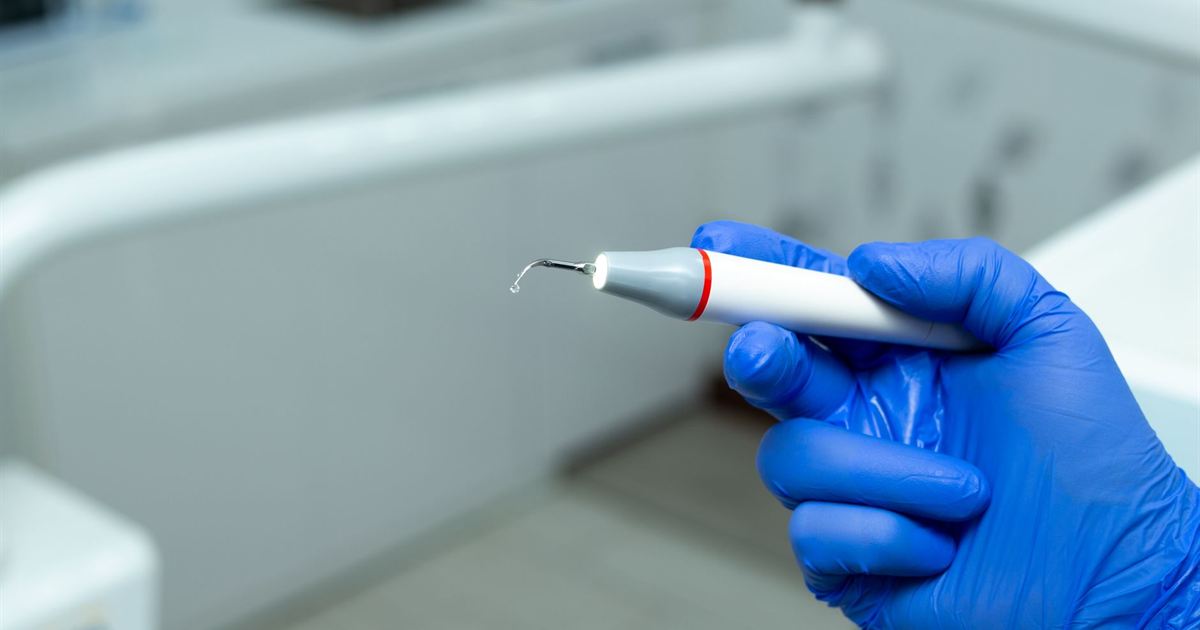
Ultrasonic scaling. A vibrating tip with water breaks up hardened deposits. You feel vibration and hear a high-pitched sound.
Hand instruments. Fine curettes clean and smooth the root surfaces, which is the part that takes time.
Irrigation. The pockets are flushed, sometimes with an antimicrobial rinse.
Local antibiotic placed into deeper pockets in some cases.
Forty-five to ninety minutes per session, and half your mouth will be numb afterward, so avoid chewing until sensation returns.
Aftercare instructions cover rinsing, brushing, and what to expect over the following days.
Recovery and What Comes After
Expect a few days of adjustment rather than a difficult recovery.
Tenderness in the gums for two to three days.
Sensitivity to cold, sometimes for a few weeks. The roots have been cleaned and are temporarily more exposed. Desensitizing toothpaste helps.
Slight bleeding when brushing for a day or two.
Gums appearing to recede. This is inflammation reducing rather than tissue being lost, and it can make teeth look slightly longer or open small gaps. It is a sign of healing and it takes people by surprise.
Warm salt water rinses and soft food for the first day or two.
Reassessment at four to eight weeks, remeasuring the pockets to see how they have responded. Reductions of one to two millimeters are a good result.
Where deep pockets persist after healing, gum surgery or referral to a periodontist is discussed. That is a normal next step rather than a failure of the treatment.
The American Academy of Periodontology publishes patient guidance on non-surgical periodontal therapy.
What Happens If You Decline
Worth stating plainly, since the cost is real and people do weigh it.
Untreated periodontitis progresses. Bone continues to be lost around the roots, pockets deepen, and the process is usually painless until teeth become loose. Bone that has gone does not grow back.
A regular cleaning instead does not reach the affected surfaces, which is why practices are reluctant to provide one as a substitute. It removes deposits above the gumline when the disease continues below it.
There is a legitimate middle path. Ask whether treatment can be staged over time to spread the cost, whether the most affected quadrants can be done first, and what the insurance position is.
Declining and doing nothing has a predictable end point. Declining and asking for a staged plan usually gets one.
A second opinion is entirely reasonable, and bring your pocket chart and X-rays with you.
FAQs About Dental Deep Cleaning
Do I really need a dental deep cleaning? It depends on your pocket measurements and bone levels, both of which are recorded and can be shown to you. Pockets of four millimeters or more with bleeding, alongside bone loss on an X-ray, is the standard basis. Ask to see your chart.
Does deep cleaning hurt? The appointment is done under local anesthetic, so you feel pressure and vibration rather than pain. Tenderness for a few days afterward and cold sensitivity for a few weeks are common. Desensitizing toothpaste helps with the sensitivity.
How long does a deep cleaning take? Forty-five to ninety minutes per section, usually across two or four appointments so that only part of your mouth is numb at a time. A reassessment appointment follows four to eight weeks later to remeasure the pockets.
Why do my gums look like they have receded afterward? Since swollen inflamed tissue has settled back to its actual position. The gum was puffy before, which hid how much attachment had already been lost. It is a sign of healing rather than damage, and it can open small gaps between teeth.
Will I need deep cleaning again? Sometimes, in specific areas that do not respond. More often you move to a three or four monthly maintenance cleaning, which is designed to prevent the pockets recolonizing. That shorter interval usually becomes permanent.
Ask to See Your Numbers
Pocket depths and X-rays are recorded at every examination, and any recommendation should be backed by both.
Call (208) 356-5601 or see our dental hygiene page.
Madison Park Dental, 345 N 2nd E Ste 2, Rexburg, ID 83440. Rated 4.9 stars across 229 Google reviews.
Reviewed by Dr. Matthew Griffeth, Madison Park Dental.This article is general information, not dental advice.
☏
Ready to book?To learn more or schedule an appointment, call Madison Park Dental at (208) 356-5601 or visit us at 345 N. 2ND E., Suite 2, Rexburg, ID 83440.
Matthew Griffeth
Dr. Matthew M. Griffeth is passionate about patient education and preventive care. His mission is to help patients achieve long-lasting oral health with simple, effective habits at home.
Keep Reading
Related Articles
Ready to Transform Your Smile?
To find out more about the dental services offered at Madison Park Dental, call (208) 356-5601 or schedule an online consultation. You can also visit us at 345 N. 2ND E., Suite 2, Rexburg, ID 83440.