Someone told you implants take a few months. Someone else said a year. Both were probably right about their own case.
The variation comes from what has to happen before the implant goes in, not from the implant itself.
A dental implant timeline typically runs three to nine months from consultation to final crown. The single longest stretch is healing, where the bone fuses to the post, and that takes the time it takes. Grafting or extraction beforehand adds months to the front end.
The Dental Implant Timeline at a Glance
For a straightforward single implant with adequate bone and no extraction needed, expect roughly three to six months. Consultation and planning takes one to two weeks. Placement is a single appointment. Healing and fusion between the bone and the post runs three to six months. Fitting the abutment and the final crown adds another two to six weeks after that. Where a tooth needs extracting first, add two to three months. Where bone grafting is needed, add four to six months.
Nine to twelve months is normal for a case that starts with an extraction and a graft.
That sounds long until you weigh it against a restoration meant to last decades.
Stage One: Consultation and Planning
One to two weeks.
The consultation establishes whether you have enough bone, whether your gums are healthy, and whether anything in your medical history changes the plan.
Expect a panoramic X-ray, often a 3D cone beam scan, and impressions or a digital scan. The 3D scan is what lets the implant position be planned against the actual anatomy, including where nerves and sinuses sit.
You leave with a written plan and a cost breakdown, and there is usually a gap of a week or two when the plan is finalized.
Our post on implant eligibility covers what is being assessed at this stage.
Stage Two: Extraction and Grafting If Needed
Zero to six months, and this is where cases diverge most.
Situation
Added time
Gap already healed, enough bone
None
Extraction needed, then implant later
2 to 3 months
Extraction with socket graft
3 to 4 months
Bone graft for volume loss
4 to 6 months
Sinus lift, upper back jaw
4 to 9 months
Immediate placement at extraction
None, where suitable
Immediate placement, where the implant goes in at the same appointment the tooth comes out, is possible in selected cases with good bone and no infection. It removes months. It is not suitable everywhere and the assessment is specific to your case.
Where an extraction is planned and an implant is a possibility later, ask about a socket graft at the same visit. Preserving bone as the tooth comes out is easier than rebuilding it.
Stage Three: Placing the Implant
One appointment, usually one to two hours.
Local anesthetic, sometimes with sedation. A small opening is made in the gum, the site is prepared, and the titanium post is placed into the bone. The gum is closed over or around it.
Most people describe it as less difficult than an extraction, and soreness for a few days afterward is normal.
Expect to take it easy for the rest of the day, eat soft food for a few days, and follow the cleaning instructions closely.
You are not leaving with a tooth. A healing cap or a temporary sits there instead, and the gap is often covered with a temporary partial denture or a bonded temporary if it is visible.
Stage Four: Healing and Fusion
Three to six months, and this is the part that cannot be shortened.
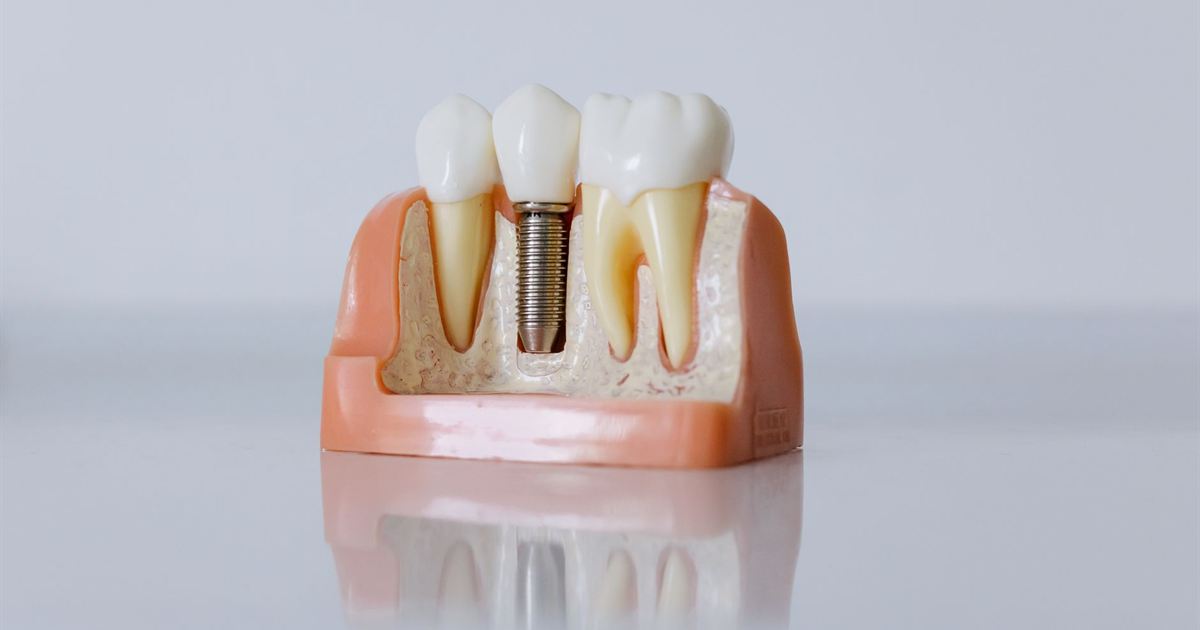
What is happening is osseointegration. Bone cells grow onto and into the surface of the titanium post until the two are locked together. That fusion is the entire basis of how an implant carries a bite load for decades.
There is no way to accelerate it and no reliable way to test it early beyond time and a check appointment.
Lower jaw sites tend toward the shorter end, since the bone is denser. Upper jaw and grafted sites tend toward the longer end.
Things that extend it: smoking, uncontrolled diabetes, and loading the site too early.
You will have one or two brief checks during this window. Otherwise you carry on normally, cleaning the area as instructed and avoiding chewing directly on it.
Stage Five: Abutment and Crown
Two to six weeks.
Once fusion is confirmed, a small connector called an abutment is attached to the post. Where the gum was closed over the implant, a minor procedure exposes it first, and the gum then shapes around the abutment for a couple of weeks.
An impression or scan is taken of the abutment, and the laboratory makes the crown. That usually runs two to three weeks.
The crown is fitted, the bite is checked and adjusted, and it is screwed or cemented into place.
That appointment is the end of the process. From there it is normal cleaning and normal checkups, covered in our implant aftercare post.
FAQs About the Dental Implant Timeline
How long does the dental implant timeline take from start to finish? Three to six months for a straightforward case with adequate bone. Nine to twelve months where an extraction and a bone graft are needed first. The longest single stage is the three to six months of healing when the bone fuses to the implant post.
Why does an implant take so long? Since bone growth sets the pace. The post has to fuse with the surrounding bone before it can carry a bite load, and that biological process takes months regardless of how the appointments are scheduled. Rushing it risks the implant failing.
Will I have a gap when I wait? Not usually a visible one. A temporary partial denture, a bonded temporary tooth, or a healing cap covers the site during healing, particularly for front teeth. Ask directly what you will be wearing, since it varies by case and by position.
Can I get a dental implant in one day? Same-day placement is possible in selected cases, meaning the post goes in at the same appointment as the extraction. Same-day teeth, where a temporary crown is fitted immediately, is possible in some cases. Neither shortens the underlying bone healing, which continues underneath.
What makes some implant cases take longer? Bone grafting, sinus lifts, extractions that need healing time, active gum disease requiring treatment first, smoking, and uncontrolled diabetes. Upper jaw sites tend to heal more slowly than lower jaw sites since the bone is less dense.
Get Your Own Timeline
A scan and an examination give you a stage-by-stage schedule for your case rather than a range.
Call (208) 356-5601 or see our dental implants page.
Madison Park Dental, 345 N 2nd E Ste 2, Rexburg, ID 83440. Rated 4.9 stars across 229 Google reviews.
Reviewed by Dr. Matthew Griffeth, Madison Park Dental.This article is general information, not dental advice.
☏
Ready to book?To learn more or schedule an appointment, call Madison Park Dental at (208) 356-5601 or visit us at 345 N. 2ND E., Suite 2, Rexburg, ID 83440.
Matthew Griffeth
Dr. Matthew M. Griffeth is passionate about patient education and preventive care. His mission is to help patients achieve long-lasting oral health with simple, effective habits at home.
Keep Reading
Related Articles
Ready to Transform Your Smile?
To find out more about the dental services offered at Madison Park Dental, call (208) 356-5601 or schedule an online consultation. You can also visit us at 345 N. 2ND E., Suite 2, Rexburg, ID 83440.