Most people are given a leaflet at the fitting appointment and are never asked about it again. Habits drift, and the two most damaging ones look like good hygiene.
Regular toothpaste and hot water are the usual culprits.
Denture care takes about five minutes a day. Rinse after eating, brush with a soft brush and a non-abrasive cleaner, soak overnight, and clean your gums and tongue separately. What you avoid matters as much as what you do.
Denture Care in Five Minutes a Day
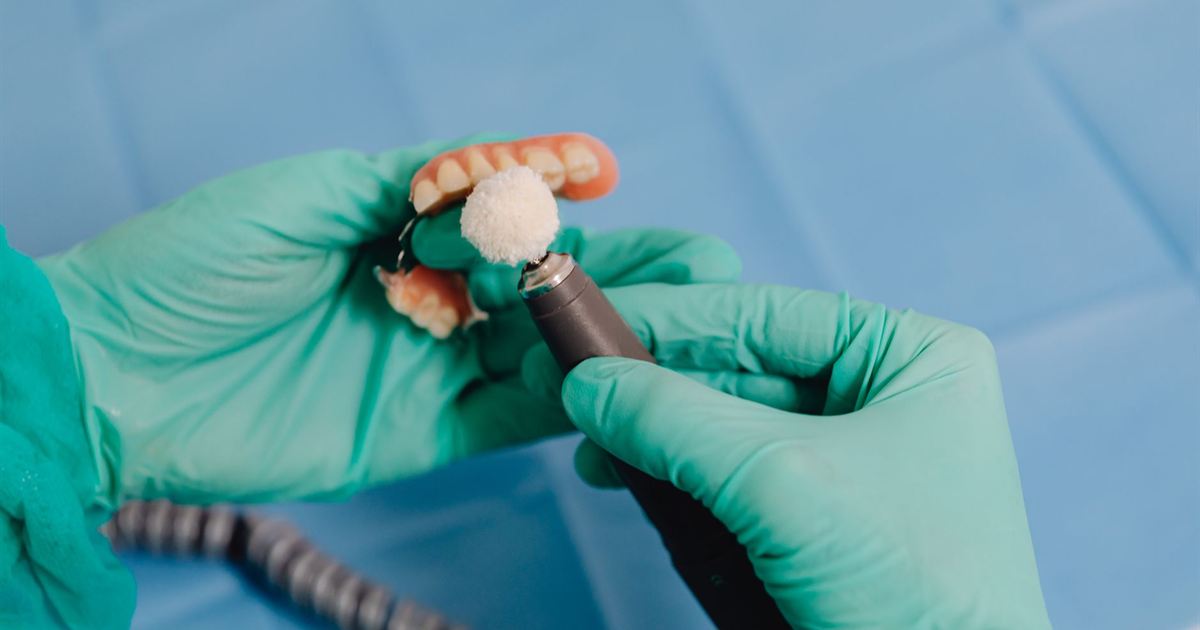
The daily routine has four parts. Rinse your dentures under running water after every meal to clear trapped food. Brush them once a day with a soft denture brush and either a denture cleaner or plain mild soap, covering every surface including the side that sits against the gum. Brush your gums, tongue, and palate with a soft toothbrush morning and night. Soak them overnight in water or a denture cleaning solution, never letting them dry out.
Always do the brushing over a folded towel or a basin of water.
Dropped dentures crack on a hard sink, and that repair is entirely avoidable.
What Not to Use, and Why
Every item here is in common use and every one causes real damage.
Avoid
What it does
Regular toothpaste
Abrasive, creates microscopic scratches that trap stain and bacteria
Hot or boiling water
Warps the acrylic permanently, ruining the fit
Bleach
Whitens the pink acrylic, weakens the material, corrodes any metal
Stiff-bristled brushes
Scratch the surface for the same reason as toothpaste
Baking soda scrubbing
Abrasive enough to dull the surface over time
Vinegar soaking, repeated
Can affect metal components
Letting them dry out
Acrylic distorts and becomes brittle
Toothpaste is the one that surprises people most. It is formulated to be mildly abrasive against enamel, which is far harder than denture acrylic. Over months it produces a network of fine scratches, and those scratches hold stain and bacteria in a way a smooth surface does not.
Hot water is the fastest way to destroy a denture. A single soak in water that is too hot can warp the fit beyond repair.
Looking After Your Gums
The part most easily forgotten, since there is nothing obvious to clean.
Take the dentures out and brush your gums, the roof of your mouth, and your tongue with a soft toothbrush morning and night. It removes plaque, stimulates the tissue, and lets you notice anything changing.
Rinse with warm salt water when the tissue feels tender.
Give the tissue a rest by leaving the dentures out overnight where you can. Continuous coverage, particularly of the palate, is the main risk factor for denture stomatitis, a fungal inflammation that shows as redness across the area the denture covers.
Signs worth an appointment: persistent redness, white patches that wipe off, a burning feeling, cracking at the corners of the mouth, or any sore that has not healed in two weeks.
Keep your regular checkups even with no natural teeth. The examination covers gum tissue, the fit of the denture, the underlying bone, and an oral cancer screening.
Overnight Storage
Two rules and they are both simple.
Take them out. Except where your dentist has in particular advised otherwise, particularly in the first week after fitting or with immediate dentures. Overnight rest reduces fungal infection risk and lets the tissue recover.
Keep them wet. Plain water or a denture soaking solution. Never dry, and never hot.
If you use a cleaning solution, rinse thoroughly before putting them back in. Soaking solutions are not meant to enter the mouth.
Store them somewhere the family dog cannot reach. This is a genuinely common way dentures are lost.
Dentures with metal parts need a solution suitable for metal, so check the packaging.
Stains, Odor and Buildup
Discoloration usually comes from the same places it does with natural teeth.
Coffee, tea, red wine, and tobacco stain acrylic, and they stain scratched acrylic much faster. That is the practical cost of years of toothpaste use.
Persistent odor usually means buildup on the fitting surface, the side against the gum. It is easy to miss since you cannot see it. Brush that surface deliberately every day.
Hard white deposits are calculus, the same mineral deposit that forms on teeth. Once hardened it does not come off at home. Do not attempt to scrape it, since the tool scratches the surface. The office removes it with an ultrasonic cleaner, usually quickly.
Ask about a professional clean at your checkup. It is a small thing that makes a noticeable difference to appearance and smell.
Where staining is deep and the surface is already scratched, a reline or a remake sometimes makes more sense than continued polishing. Our post on denture relines covers when that point arrives.
Adhesives, Used Properly
Adhesive is fine when it is helping a well-fitting denture and a warning sign when it is compensating for a poor one.
Used correctly: a thin layer applied to a clean, slightly damp denture, in small dots or short strips rather than a coating. More adhesive does not improve hold and it makes removal messy.
Clean it off completely each day, from both the denture and your gums. Residue left in place traps bacteria against the tissue.
The warning sign: needing steadily more adhesive over months. That means the fit has changed, usually since the bone underneath has resorbed. The answer is a reline, not a bigger tube.
Adhesive cannot correct a denture that no longer fits. It masks the problem when the underlying tissue takes the load unevenly.
The American College of Prosthodontists publishes patient guidance on denture care and wear.
FAQs About Denture Care
Can I clean my dentures with regular toothpaste? No. Toothpaste is abrasive enough to scratch denture acrylic, and those scratches trap stain and bacteria permanently. Use a denture cleaner, a purpose-made paste, or plain mild soap with a soft denture brush.
Should I soak my dentures overnight? Yes, in water or a denture cleaning solution. Acrylic distorts if it dries out, and leaving the dentures out overnight gives your gums a rest, which lowers the risk of fungal infection. Never soak in hot water, which warps the fit permanently.
How do I get rid of denture smell? Almost always buildup on the fitting surface against the gum, which is easy to overlook. Brush that surface deliberately every day, soak overnight, and clean your gums and tongue separately. Persistent odor after that warrants a professional clean.
Why do my dentures need more adhesive than they used to? Since the fit has changed. The bone under the gum gradually resorbs after teeth are lost, so a denture that fitted well two years ago sits differently now. The answer is a reline or a remake, and adhesive only masks it.
Do I still need dental checkups with full dentures? Yes. Checkups assess gum health, denture fit, bone changes, and include an oral cancer screening. Problems with the tissue underneath are usually painless in the early stages and are found at an examination rather than noticed at home.
Book a Denture Check
Fit changes gradually enough that most people do not notice until something hurts. A yearly check catches it earlier.
Call (208) 356-5601 or see our dentures page.
Madison Park Dental, 345 N 2nd E Ste 2, Rexburg, ID 83440. Rated 4.9 stars across 229 Google reviews.
Reviewed by Dr. Matthew Griffeth, Madison Park Dental.This article is general information, not dental advice.
☏
Ready to book?To learn more or schedule an appointment, call Madison Park Dental at (208) 356-5601 or visit us at 345 N. 2ND E., Suite 2, Rexburg, ID 83440.
Matthew Griffeth
Dr. Matthew M. Griffeth is passionate about patient education and preventive care. His mission is to help patients achieve long-lasting oral health with simple, effective habits at home.
Keep Reading
Related Articles
Ready to Transform Your Smile?
To find out more about the dental services offered at Madison Park Dental, call (208) 356-5601 or schedule an online consultation. You can also visit us at 345 N. 2ND E., Suite 2, Rexburg, ID 83440.